The New Parent Child Seat Experience

New Father: I am the lone line of defense between my offspring and the harsh world. I would give my life for my child. I am on high alert, everything I have done in my life has led to this and I am ready to do whatever it takes to provide for them. I will install this seat with the care of a surgeon mechanic warrior poet. It will carry the very embodiment of my legacy.

New Mother: i’m just gonna go ask a hunky fireman to buckle this seat in.

I Just Want Taylor to be Happy

An essay about football…and a couple of other things.

I just want Taylor to be happy.

I guess I realized it on Super Bowl Sunday. The lead-up to the game included all kinds of packaged pieces about the players’ lives and families – you know, stuff chicks like.

There was a big story about fathers and daughters. Not to be confused with the now-accepted but stupid term “#girldad” (as if the term “dad” is inadequate), this was a story about how Sundays were previously reserved for fathers to numb themselves to the world around them and be ignored by their daughters for 3-12 hours.

But lo and behold, now they are times that fathers can enjoy watching grown men maim and concuss each other alongside all their children, even the girls!

Taylor had brought families together.

We are a Sunday football family. I don’t think my daughters are that into it – I’m just a dad and not a #girldad so I don’t pay much attention to them – but my wife and I watch it from pre-game till bedtime. Red Zone especially. I am a lifelong Cowboys fan (in varying stages of grief) but she just loves all of it. We watch Hard Knocks. We watch(ed) Sam Ponder on ESPN prior to her firing and replacement by another host with a beard that came straight out of a focus group.

We are not posers. We are legit fans of the sport. It’s brutal and probably a bad way to spend hours of our existence, but we love it.

We are not fans of the Kansas City Chiefs, per se – but we’re not haters either. We like to watch all the teams. And, since Red Zone cuts to touchdowns, we watch a lot of the Chiefs. Moreso, since they get the prime time games, we watch a lot of them then too.

So when it started happening – the cuts to the box – there was a murmur.

There is a Swiftie in my house.

And not a poser. A legit fan.

A fan to the point of it being dicey when someone outside the house makes a snide comment. If we are in public, or, say, at a family gathering, we dare not laugh at a Taylor joke, we just pretend not to hear it and hope we make it home without seeing bloodshed.

There was an anti-Taylor comment made in our presence in 2020 that still gets quoted derisively in the house. 

Swifties don’t forget.

It’s charming when Tony Romo and Jim Nantz refer to the camera catching Tay in the luxury box, awkwardly sharing oxygen with Brit. That murmur I mentioned – yeah, it was me. I have yelled across the house before “there she is!” so I’m not pretending to be above the fray here. It’s nice to feel justified in my football-watching, and having a common interest makes me feel less guilty when I refuse to help with homework because the Vikes and Seahawks are tied in the 3rd quarter of a pivotal October matchup.

So to be clear from the outset – I like it all. I like Tay-Tay, I like football, I like good football, I like the Chiefs, I like the camera-cuts, I like Tony Romo, I like the Cowboys.

But.

I fear.


He sat in a dank prison cell, days from his home, never to see his family again.

And his concern was how to tell the others what was really going on.

He could not say it plainly. The political environment was so toxic that he risked his life – what was left of it – by speaking the truth.

His options were to be silent or to find a way to say it secretly.

His education came back to him. The texts he had studied, recited, written and taught, that were so often misunderstood by people, were in fact the key for him to relay his message.

This governmental abuse was not new. He recognized it, the pattern, the techniques, the inevitable outcomes. But more than that, he recognized the desire that was as old as time – the desire for power. Not power over weaker people, but power to get back at the strong, the bad people who had done damage. If the good people could just get the power back, they could make things right. But they had to find a way to get the power – whatever it took.

John knew the temptation for his friends to seek power was so strong that he was willing to risk his life to open their eyes. Ironic then that the only way to reveal this truth was to hide it in codes and symbols. John had to give his community an apocalypsis – a revelation.


Tom Cruise went to the Olympics. Did you see him? At the men’s basketball Gold Medal game, they cut to him several times. Top Gun came out in 1986. His 7th (not a joke) Mission Impossible movie came out in 2023.

The biggest American movie star of the past 40 years was on hand as the most famous American professional athletes competed for the most important sporting award in the world.

Am I alone in thinking it felt small compared to any Taylor sighting at Arrowhead? That time they-did they?-wheel her in hidden in a cargo cabinet to avoid the crowds? 

Not to mention that time she and Travis met on the field after he won the Super Bowl? All-time, right? Maverick’s got nothing on that.

Taylor is as big as it gets.

I tread carefully here, but I am going to say that I understand a little more of her popularity now that I have seen the concert film. Okay, I only made it through a couple eras, but I tried.

The themes are universal, the music is good. There is a massive volume of it. But her effort is attractive. There are some awkward moments in her performance, but she it so committed that it becomes endearing. She is not other-worldly, she maintains her commonality to an exponential degree. The awkwardness tells us she is not conning us. If she was perfect, we wouldn’t trust her, because we know that no one’s perfect.


A great sign appeared in heaven: a woman clothed with the sun, with the moon under her feet and a crown of twelve stars on her head. She was pregnant and cried out in pain as she was about to give birth. Then another sign appeared in heaven: an enormous red dragon with seven heads and ten horns and seven crowns on its heads. Its tail swept a third of the stars out of the sky and flung them to the earth. The dragon stood in front of the woman who was about to give birth, so that it might devour her child the moment he was born.

The first generation held out hope.

They had been the ones to see him, to hear him. Even if they hadn’t, they had friends who did. Who heard him teach. Maybe they even knew someone who saw a healing.

But the first generation were dying.

The second generation had grown up hearing about it. And while they believed, they believed differently. They had a hard time understanding what the waiting meant. What were they supposed to believe living in a world that was bound to be changed, but so far had been the same, year after year? The worst times were past – the times of government-sponsored murder – but it was still not the world the first generation promised them.

So, with the second generation’s stories in mind, of the terrible time, the third generation found a way to prevent it from happening again – they could take power now because the government could be changed, finally. All they had to do was make a few agreements, a few trade-offs. Their grandparents would never have approved, but they were gone now. They were a new generation, one that had to prove they were able to make things right.

So they agreed to the compromises – give a little to get a little. Maybe the words aren’t the same, but they could get what they wanted – get the laws changed in their favor, get the funding for facilities, get out of the shadows. They might have to share the new buildings with their new partners. They might have to send some of their money to some different people, some people who had helped them get this new power. They might have to go along with laws they didn’t like, but which, when you think about it, didn’t relate to them anyway. They could finally get their friends out of exile. It was worth the compromise.


Do you listen to SiriusXM? I love it. I have 5-6 favorite channels. Among them is channel 26, “Life”with John Mayer.

But I have to hide that preset. Not hide, really, but I don’t leave it on there. John Mayer got a song written about him by Taylor. They dated, but it doesn’t seem to have ended well.

So John’s on a list.

It’s a fun list. Everyone on the list is doing fine. They all have a different career path, and whatever they did to earn a song from Taylor didn’t seem to end them.

Some of them are still friends with her, which is very nice.

But most of them, they belong to a different list as well.

They are blacklisted by Swifties. The word cancelled may or may not get tossed around. As far as my experience tells me, John Mayer is on the cancelled list.

That new MMA movie looks interesting, maybe not great, but I’d be curious about it if it didn’t star Jake Gyllenhaal, who’s on the list. I fear even searching for it on Apple TV, it might remain in my search history. And Taylor’s history of search has left a trail of men that are better off not mentioned in the house.


Then war broke out in heaven. Michael and his angels fought against the dragon, and the dragon and his angels fought back. But he was not strong enough, and they lost their place in heaven. The great dragon was hurled down…to the earth, and his angels with him.

They were called Ladies’ Teas. They were ostensibly a gathering of women of churches across America to interact with a live video feed of Laura Bush, first lady at the time, discussing issues relevant to women of faith.

As one not a woman of faith, I don’t know what was discussed, or how the event went off. I just remember hearing about them before they happened and then hearing about what happened afterward.

The organizers of the event, upon its completion, asked women to send in (mail I suppose?) copies of their church directories, which listed, in most cases, the names, addresses, and phone numbers of fellow church members. I have to assume this was presented as a means of accomplishing the goals and desires discussed during the “Tea”. Why not just let the folks at the national level reach out to as many people as possible to make sure the word of this good work was getting out?

Someone caught on fairly quickly and protested that it was not appropriate to ask people to send this private tax-exempt church’s information to a government entity.

Good catch. Not sure how they didn’t see it coming, though.

Because those who seek power can rarely be trusted with power.


The Chads and Brads took to social media to complain about the Taylor takeover of football broadcasts. Taylor smote them in clear and convincing fashion.

But the Chads and Brads were right.

If the most sacred institution you have begins to rely on an outside source for attention and authority, you are screwed. You have ceded power to something you no longer truly know or understand. You should fear this. You should protest this.

If…

If that is the most sacred institution you have.

We watch a lot of football. We love watching and love spending the time together. But never on Goodell’s green earth would we use the word sacred. Or even important. It’s entertainment. That’s it.

Music is different. It’s personal, which is why churches split over it. I love music. I cherish music. There are moments in my life that are more sacred because of the music that was sung at the same time. It is this way for us all. Weddings, funerals, family members playing songs for dying parents, spouses, children. These are sacred. Not because of the singers, but because they are a doorway via the creativity that is distinctively human into the realm of the divine.

That is a power that is transcendent. So of course football will lose to it. They can both be entertaining, and it’s okay. It’s okay to like them, love them to some degree. Taylor Swift is not music, she is a musician. She is less than transcendent, but her music is transcendent for many.

This should be terrifying to someone who believes a sport is the highest point of existence. While that’s not me, I still want her to be happy with Travis. I want to see them smiling on my television once a week in the Autumn. I want them to be a pleasant element for an entertaining day.

My fear, of course, is that if she dumps Travis, I would have to hide football like I hide my John Mayer CDs.

But I’m not at risk of losing my soul.


The cliche is that politics make strange bedfellows. I have seen tea-totaling pastors and liquor stores protest the same ballot measure. The enemy of my enemy is my friend and all that. This is power thinking.

People who support separation of Church and State have a common enemy — the lies that one side tells the other.

The church that wants political power will be manipulated by politicians who dangle the power as bait. The politician will lie about how much power he will be sharing. The church will lie to itself about how much it’s willing to tolerate.

The politician who wants church support will be bound to a narrow set of values despite her job to govern a broad population. The church will lie to maintain its power over the politician. The politician will lie to herself about her decisions to govern well for her entire community.


The woman was given the two wings of a great eagle, so that she might fly to the place prepared for her in the wilderness, where she would be taken care of for a time, times and half a time, out of the serpent’s reach. Then from his mouth the serpent spewed water like a river, to overtake the woman and sweep her away with the torrent.1


Power is a drug – the more it’s desired, the more dangerous it is.

Beware the one who seeks power by all means. Power that is given is one thing, but power that is coerced, pulled, demanded, romanced, and sweet-talked always turns into something else. That’s what John the Revelator knew. Give the emperor what the emperor deserves, don’t give up the sacred, your being, your baby, in order to win what the emperor seeks. When you think of power as a commodity, you will be proven correct. And you will never be the one who gets more of it.


1 This and all previous block quotes from The Revelation of John, chapter 12, New International Version

July, 2024

A (very) Personal Essay about Superpowers

It was a revelation, in the same way getting a physical after 40 is a revelation.

I texted Lex as soon as it sunk in.

Out-of-context text messages with sweeping existential generalizations are probably not the best way to touch base with old friends, but I had to know if I was on an island, and if so, how big the island was.

“Are we all just making it up?”

I had a falling out with someone I considered a friend, but realized was not.

This followed—immediately followed—a conversation with someone I considered a friend, but realized later that we didn’t really even know one another.

What did those encounters have in common, I asked myself for a few days. I replayed each conversation over and over, exaggerating the awkward parts more each time. One had been an outburst, my outburst, followed by the other’s continued dismissive and increasingly hostile public response. The other, a private conversation that had begun in a place of safety and excitement but had been carried forward by an undercurrent of power and religious guilt.

The common thread, the only one I could pin down, was the way I felt after each one. Head spinning, knocked onto my heels. A strange, new sensation, a mix of anger, shock, and awareness.

I think I reached self-actualization.

(Make that anger, shock, awareness, and pretense.)

I am drawn to marketing because I think a lot, and one of the main things I think about is what other people think. A few years ago I came to the realization that this was, along with predicting the future, my superpower. I texted Lex about that, too.

I am not good in groups. I am not good in public. I used to be. But now, I get exhausted from the work of trying to decipher people’s intentions. One shortcut I have found is to assume the worst. Of course this is a protective mechanism. It is one that I’ve had to build. It keeps me from trusting people or situations that are not trustworthy, because I kept finding myself in untrustworthy scenarios. Mostly, it was due to my eagerness to please, defuse, or escape conversations instead of engage and express. When I get nervous, I start agreeing to whatever someone says, just hoping to get out of the conversation and back to my pickup or recliner. Right? Right?

So, if I assume people are self-absorbed or disrespectful, I don’t have to be let down. If I am wrong, I am happily wrong. As long as I don’t tip my hand, I can be cynical and distant, and only when I find someone who speaks the same language or has the same humor or is frustrated by the same situations will I let enough of my guard down to, possibly, connect.

The result of this constant wall-building is that I have a stockpile of trust to be placed in a scarcity of people.

I don’t know if trust is earned or given. Seems like people have an opinion on that. While I don’t, I do know that within us is an innate desire to trust people. This desire can be misplaced and lead to pain, heartbreak, and even devastation. But the healing of that devastation will involve rebuilding that ability to trust—alongside a development of discernment as to who is actually trustworthy.

So, trust is good. I say that as an untrusting person.

But if I withhold it, it wells up and needs some place to be directed. My tendency is to place it—in large quantities—into certain people.

In both of the interactions I mentioned earlier, I had placed too much trust in someone.

I was not devastated—or even hurt—by these people. That’s what was so strange about the feeling I had at these pivotal points. Pain is obvious, but awareness is shocking.

Have you ever sat at a red light only to find out the green light isn’t working? So the red light goes off and nothing happens?

Worse, have you ever driven through a green light when the driver checking their phone in the intersecting lane wasn’t paying attention to their red light?

When the thing you trust fails, it’s difficult, but understandable.

When the person you trust fails, it’s difficult, and painful. But eventually, you at least understand the cause of the failure, and have somewhere to put the blame.

But when you realize it’s not the other person who has failed, but you, that’s the wind-knocked-out feeling I had. I gave more trust than was earned—like pouring a gallon of water into an 8 ounce cup, it was unreasonable. Illogical. It was unfair.

It was not fair to expect anyone to know more—so much more—than I know. After all, I know the future.

My logic has always been, whether I admitted it or not, that if I trust someone, that must mean they know the future plus more.

It turns out that it’s not their knowledge I trusted, it was their confidence. And by confidence, I mean arrogance.

There are people—the people who are loud and successful enough to mistake their success for ability—whose confidence outruns their knowledge by so much that they lose sight of reality.

These people are easy to follow.

If you were lost in the proverbial desert, with a group of other people, who would you choose to follow? The person who, lying, says, “Follow me, I know where to go!” Or the person who, honestly, says, “I can’t be sure, but we have to try this direction if we’re going to have a chance.”

The fact that you don’t know who is lying or honest means you must choose the one who tells you they can help. It would be foolish to do otherwise.

But eventually, you’ll realize they were lying. Probably, they were even lying to themselves. But survivorship bias means that the ones who are around and say they know sure look like they know. So that’s who we follow.

I don’t blame many of these people for believing themselves. They are often trapped. They have to keep up appearances, or maintain credibility, or fake it until they really do make it.

And while you’re probably imagining someone sinister right now, I’ve pretty much described what it is to be a parent. So take it easy on us!

No, the pain is not being lied to. The pain is realizing you let yourself be lied to. Worse, that you went looking for it.

My devastating realization was that I can’t know what people are thinking—mind-reading is not possible. I can guess, and even tell myself I am right. But I can’t actually do it.

The accompanying realization was that I can’t predict the future—neither can they—no one can. If I make a guess and I’m right, okay. But that’s just what humans do—anticipate. Hopefully better and better with age, but it’s never actually knowing the future.

It turns out that what I always considered my superpowers were just cognitive distortions.

“If your every sentence admits a doubt, your writing will lack authority.” Strunk & White p. 20

“If your pastor tells you every Sunday what an awful sinner he is, then pretty soon you’ll start to wonder if he should be your pastor!” James Heflin

This is such a strange dance we are doing, dear reader. I am at that point in life where I know some things well, and I assume everyone knows them as well. But there’s so much in this big terrifying broken stupid beautiful world that I don’t know. You don’t want me to list those things, or tell you how much I don’t know. You’re here, after all, to receive something.

And ignorance is, of course, nothing.

So here are my options:

Make something up. At least then it’s a something. And if I really try, I can give you the context, experience, stories, and body language that will let us both agree that I know what I’m talking about—which is more than you. This is probably more easily described as “Marketing.”

Stick to what I know.

Option 1 is a rope bridge above a death-deep canyon. And although I can tell you to ignore the “noise” that is actually fraying rope, there will come a point where you will drop, just like I did, and find yourself falling.

Hopefully, you’ll have a friend like Lex willing to text you back with helpful words.

Or, if we choose Option 2, you’re going to have to bear with me when I tell you authoritatively about something you know more about than I. This is just how it has to work.

The problem—and the solution—is that I’m not content with what I know. So, I’ll learn until this pasture-dented brain can’t learn anymore. And when I know something—really know it—I’ll let you know, too.

What I can’t do is fake it. What I have to do is tell it.

Maybe it will make a connection for you, to see the thing in a different, new, better way. Maybe it’s not relevant right now, but someday, it will click into place, a rusted old tumbler in a lock you didn’t know needed opening.

I’m willing to swing and miss.

You’re just going to have to trust that I’m not making it all up.

Low Rank

A fictional short story about work frustrations.

I had been there two months, and I had enough. I pounded the wrought iron screen door with my fist—supposed to be a knock, but I was too fired up.

If you haven’t actually actually worked in the silage pit, you can’t appreciate the smell of fermented corn. I don’t know how the big calves that were being fatted up in the pens ate it, but as long as it wasn’t too rotten smelling, they were happy to see the truck roll up to the feed bunks with it.

Like most bad smells, it stings your nose, stays with you after you’ve left the place. But worse is that when you’ve worked in it, it’s on you.

Your boots, your jeans, your hands—or gloves if you were smart.

The silage pit ain’t a place, it’s a sentence.

That’s why Mr Graham built it 2 miles down the road, to the East. The wind almost never blows from the East, so the smell wouldn’t make it to Headquarters, or Mrs Graham’s nose.

I managed to avoid it as a life sentence, but Ray Lowdermilk wasn’t so lucky.

Come to think of it, none of us were lucky, since we all had to work with Ray. Lucky for me, that wasn’t often.

Mrs. Graham cooked lunch for us—those of us without wives—every weekday, and served it in a big room off the back of the main house. We were off Saturday at noon and all of Sunday, and we quit every day at six, plenty of time to fix our own suppers. Occasionally, one of the wives would have to go to town, and Mrs Graham would set an extra place for her husband in the lunch room. When we knew it would be Ray sitting there, so on those days we ate fast and got out.

Unluckiest of all was Mrs. Lowdermilk.

I couldn’t understand it when the other cowboys told me—but I still believed it, the smell was all the proof I needed.

“Ray takes one bath a week—Saturday night. That’s it.”

“You just volunteer to work with him Monday and hope Mr Graham assigns you elsewhere the rest of the week.”

How does Mrs Lowdermilk—sweet, old, happy Mrs Lowdermilk—stand it?

“I dunno. Some people just can’t smell it I reckon.”

Just a few weeks ago, we found a cow that had hidden on the back side of the place for months, in the breaks and cholla. Even in this flat country, there are places you can’t see. Smith says those of us who grew up around here are worse about it. We’ve never had to hunt to gather cattle, we get lazy since we can see all of em from miles off. He brags about how he grew up in the rocks and trees of the hill country, that he could find a mute newborn calf even if you dressed it in army fatigues.

But even he missed this cow.

We only found her by accident, when the north neighbor had a bull out. We rode the fence, looking for it, since Mr Graham was always worried about nosy neighbors coming on his place. We saw her duck into a wash, just behind the playa dam, but something was odd—her shape wasn’t right—something held her tail up. She stopped to wait us out, but we found her and the shape made sense. She had started calving but had trouble, hip lock probably, never got it out.

Calving season had ended a month ago.

We tried roping, but with only two of us, we’d never get her down, not enough to work on her. Plus, the smell was awful. We had to drive, pen and push her into the chute. The decay was so far along we couldn’t believe she hadn’t gone septic. It took four of us, both chains, three knives and a hacksaw.

That smell, and the aftermath of Davis’ sick, is still in my nose.

Still ain’t as bad as Ray on a Saturday.

And now it was Saturday.

I had seen the clouds forming. Smith was gone for a trip downstate to visit family. Davis’s boy—the one he liked—got put in the hospital Thursday with the flu.

We got Sundays off, as long as we had enough work done by Saturday noon to keep everything fed til Monday. We were behind since we were short-handed. So I got assigned to the pit. Riding out to the pit in his rank bobtail truck, every bounce shook dust and stink from the cloth bench seat.

Ray was oblivious. I guess. How could he not know? I hadn’t seen anyone bring it up directly to him, and there wasn’t a whole lot going on behind the eyes, but he had to know. Why else would a feller avoid being clean?

We backed up the bobtail to the enormous pile of fermented corn and maize, where the bucket tractor was parked.

“Mr Graham likes a clean operation,” Ray said to me, for the 3rd time this morning.

Yes sir.

He climbed onto the tractor, and fired it up. Letting it warm up, he motioned over to one of the concrete walls that held the loose matter into a pile. A big metal scoop shovel swayed on the wall, hung by its handle on a piece of rebar, a big half-circle rubbed on the wall from it swinging back and forth. A gritty black-spotted sheen of smile.

I grabbed the shovel, hanging my head at what it took to keep a clean operation clean.

The first several loads were fast enough, Ray drove the John Deere’s front loading bucket into the pile, picked up a load then reversed out, to dump it into the bobtail truck’s dump bed.

But then he started looking at me, smirking. So the next few loads, he “accidentally” spilled some between the pit and the truck, giving me something to do. I shoveled and tried throwing it over the side of the bed, but the wind was up. So I had to either wait for him to slow down or climb the steps up the cab and throw it in from there.

This part of the pile smelled fine, the fermenting was prime. But an hour in, he hit an old pile, and the vinegar smell released a cloud I swear I could see.

His face lit up with a gritty, black-spotted sheen of a smile.

The “drops” got bigger. More shoveling. The spring sun was rising, not hot, but not cool either. The wind was picking up, and any time I was down wind, the clumps and clouds were bigger too.

This continued for an hour. Under my breath I was cursing. Cursing Ray. Cursing corn. Cursing Mr Graham for not buying a bigger tractor, one that would make this all go faster.

By the time I had enough, the truck was full.

I turned to take the shovel back when the pile hit my face. Wet strips of stink suffocated me, sticking to my mouth. By the time my shock wore off, I heard Ray laughing, his raspy cackle as he killed the tractor and began climbing back down.

“I gotcha good there, boy!”

I raised the shovel out of instinct, like a weapon, but he was laughing so hard and I choked on the smell and gagged. I had only enough strength to slam the thing to the ground and stumble off, looking for a hydrant or a hose or anything. I found a water faucet, next to the rusted metal stock tank in the abadoned pens where the hay was stored.

Must’ve been an hour later, I calmed down enough to get into the passenger side of the truck, waking Ray from his nap. This made me mad again, but I knew to keep my mouth shut if I wanted a ride back to HQ.

“Don’t you let him in this house,” I could hear Mrs Graham command her husband from the kitchen as he opened the wrought iron screen door.

“Step out here with me and tell me what’s on your mind, son.”

Mr Graham, I can’t do it. It’s too much. You gotta decide if it’s him or me. That dopey old sumbitch knows what he’s doing, he’s making us all sick and this is not what I signed up for.

“Well, the silage pit, it’s a necessary evil. And he does stink. But if I let him go, he’d have to find somewhere else to live, another job, I couldn’t very well do that to a man and his wife. And son, if he was gone, you’d be the one that had to work the pit.”

The blood turning my face red must’ve left quick—Mr Graham hadn’t showed me a mean look, but his directness was softening when he saw how this reasoning caught me off guard.

“It’s as good as Sunday now, take a day to cool off and let’s talk Monday. The fellers say you’re good with a rope, this is probably a good place for you to work, but if you want to move on, it’s no hard feelings. Sound fine?”

Yessir.

He was right. More than right. My bunk was a good setup for me—private, big, bigger than any I’d been in. And this place was a real operation. He’d hired me for calving season, but then asked me to stay on through calf-working, which was approaching now. Although I saw him almost every day at lunch, I had only talked to him alone those two times. He had always been kind but firm. Direct but not short. The others revered him. If I could hang around, it might be the kind of operation I could find my place. The more I put the reality of it together, the more embarassed I was about it. Ray and his wife had a house on the place. Who knows how long they’d been here. Who was I to ask for a man—sumbitch or not—to lose his job and home?

By Monday, I was glad Smith and Davis had been gone. If they’d found out what I said, how I acted Saturday, I don’t know what they would have said or done to me. I regretted embarassing myself in front of Mr Graham, but the torment of those two doggin on me would’ve sent me packing for sure.

I planned to work as usual Monday, but I wasn’t going to risk another Saturday. At sunrise, I was at Mr Graham’s front door, ready to apologize. I would take my lumps for another month then leave. He paid well but I could find work anywhere now that summer was close.

Mrs Graham answered the door, her apron on. Turned out the old man was gone for the day, something about the bank. So I worked the day. We were still shorthanded, but not enough for me to be around Ray. I got to ride solo all day, checking pastures and water.

Late Monday, I decided to wait until Mr Graham found me to talk about things. I didn’t want to tell him I was quitting, even if it was a ways off. He didn’t come looking Tuesday, so more of the same.

Except for lunch.

When I saw the place setting in Ray’s spot, I tipped my hat to Mrs Graham, closed the door and saddled back up. I could skip. Still had a biscuit from yesterday in my room, anyway.

Wednesday morning. Davis knocked on the bunk room door, waking me up.

“I’m back, we’re on fence today—neighbor’s bull again.”

All right.

He turned around to light a cigarette and walk to his pickup. I let the door close and got dressed.

Back to HQ at lunch, we could hear Smith laughing as we walked toward the lunch room. When we opened the door, Mrs Graham was covering her mouth, hiding her laughter, eyes squinting with a smile.

Smith stood when we entered and raised his hands, “Boys! We’ve been saved by the mercy of God and the wonders of modern medicine!”

“Stop it, Samuel!” Mrs Graham laughed.

“Ma’am?” Davis was as confused as me.

“Good to see you for lunch today,” Mrs. Graham said looking past Davis, right at me. I felt embarassed again, lowered my head, but she was kind about it. “Don’t worry, you won’t have to skip any more meals because of table companions,” her eyes were kind.

“To the dentist!” Smith shouted, lifting his glass of iced tea like a salute. “For the first time in her life, ol’ Mrs Lowdermilk went to the dentist. Now he’s gotta…” he laughed again and choked on a piece of ice.

“Apparently,” Mrs Graham picked up, “the removal of an impacted tooth can relieve olfactory blockages—she can smell again.”

“She threw his clothes in the yard and whooped his ass when she got home and could finally smell him!” Smith howled and Mrs. Graham threw her dish towel in his face.
Guard rails

There are (at least) two types of guard rails.

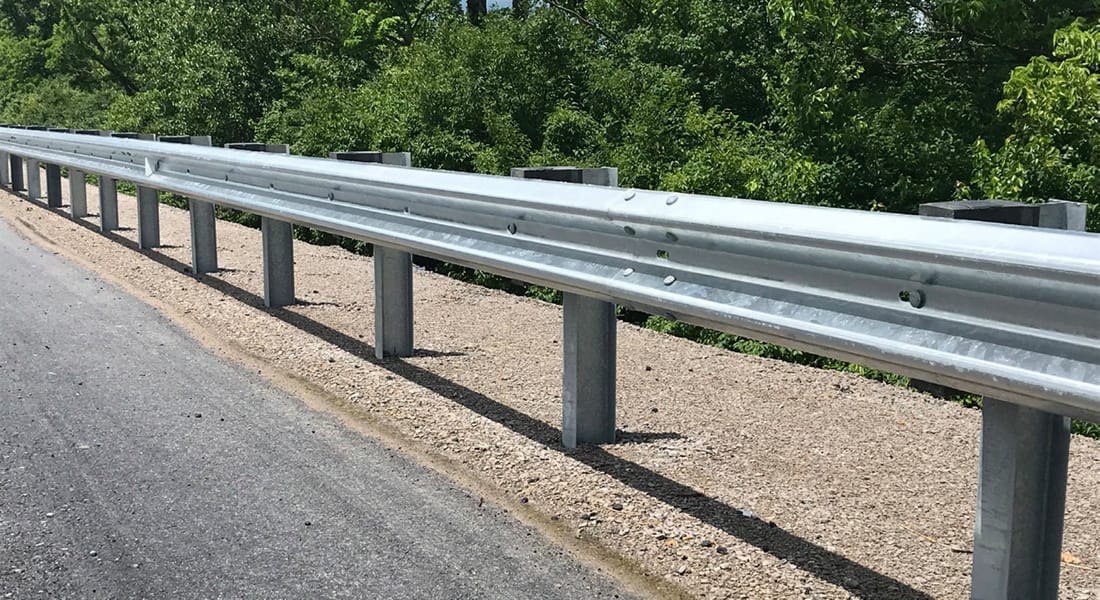
The first kind is the kind you see. The big, curvy, silver galvanized metal barriers that are put up on the sides of highways. They are used leading up to and out of an overpass, or along curves that might be more dangerous than usual. They are hopefully never used. They are important, but only needed if a driver has lost control.

The other kind is the kind you don’t see. They are laid just inside railroad tracks at key points. They are used at turns, merges and other places where the rail wheels might lose contact with the track. They provide a boundary, a way to secure the train as it turns. They are used often and helpfully so. They are important because they prevent the loss of control.

Thanks for reading Notes from Red Tower! Subscribe for free to receive new posts and support my work.

Grayed Expectations

An essay on pictures…with pictures!

Hey, remember film photography?

It used to be called “photography.”

In fact, if you call it “film photography,” it’s likely that you are a photographer who talks about it enough that you have to distinguish. Digital photography is now just called “photography.”

Now that film photography has turned into a time machine, few people younger than 40 understand the commitment of a roll of film.

While these sound like the opening statements of an old man left at a forgotten station while the train of time rolls on, I think it’s all pretty great.

Sure, there are drawbacks to the flooding of servers in unknown locations, aka “the cloud,” but the fact that every little kid grows up taking pictures as often and easily as we used to throw rocks is pretty cool.

In fact, some of those kids get bored with the thousands of pictures they take by the time they are teenagers and actually get interested in the time machine of “film photography.” They are buying film cameras from the 90s—that we would have called cutting edge—because they’re cheap and available. They’re okay spending $5 for a roll of film, and $20 to mail it and get it developed, because they have discovered the exact type of film that produces a look they like, a look that I would call nostalgic, but they call vintage. Or old.

While these few get it, most others their age don’t know that when you shoot film, you have to commit to several things:

  1. 24 or 36 exposures
  2. Waiting weeks to get the pictures back
  3. Color or Black and White

I like that these commitments exist in a new way now. The time factor wasn’t around when drug stores and Wal-Marts developed overnight. But now that everything has to be sent off to a specialty lab, it’s an added level of commitment.

But my favorite commitment is color vs black & white. Very few film photographs on Instagram are black & white, because the color films are different enough from modern iPhone pics that they are interesting.

In the old days, we considered black & white to be vintage. Or old. But now, black & white has lost its appeal, at least on social media. A notable exception here is the work of Alan Schaffer, who has become a bit of a photography rock star for his black & white images. The “old” pictures that are still around in picture frames or photo albums are not black & white, they’re Kodak. Black & whites belong in museums.

What is interesting is that even in this context, there are digital cameras being produced and sold that only shoot black & white.

Sounds odd at first blush, right? What kind of weirdo limits themselves to black & white when any digital camera can do both?

This’n.

I got one because I have never understood black & white photography. I mean, obviously I understood the difference. I just didn’t understand why some pictures are good in black & white and some are good in color.

My first thoughts, after picking photography back up in 2019, were that if the colors weren’t pretty, then edit it into black & white. If the sun is too bright, too high in the sky, it washes out the color of the image. So just switch those to black & white in the editor and see if they work. It was my format of last resort. More often than not, the image just didn’t “work” in either color or BnW, so it got tossed.

Sometimes the only way to learn something is to learn it.

I started shooting a few images with the “monochrome” mode of my primary camera. It made some interesting shots.

But even when the shots were interesting, they were just edits, versions of the original. I always felt like black & white was a lesser version of the original. Derivative. But I heard and saw photographers I respected talk about it in a way that implied they saw something I did not.

I tend to get obsessive about new ideas, and this one started to really dig in. What, really, is black & white? What am I missing?

So, I bit the bullet. I got one of the “monochrome” versions of a favorite brand of mine. And then I just shot it for a while.

I remembered a line I’d heard in the past: color photography captures the image, black & white captures the soul.

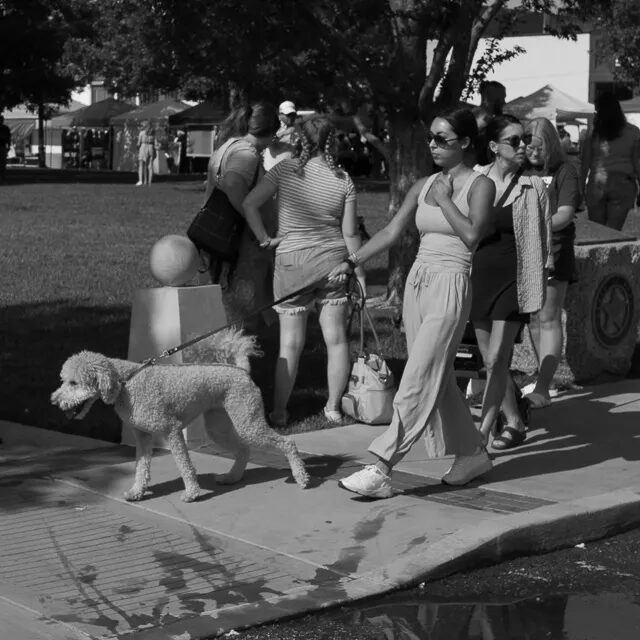
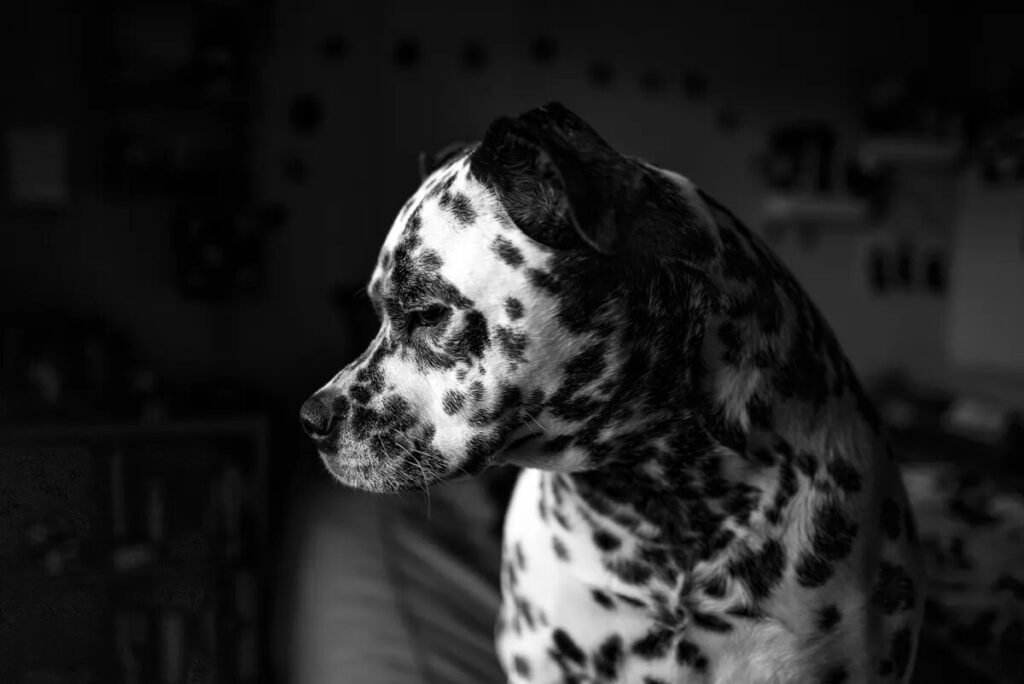
But what if you’re still in the pre-portrait phase of photography, like I am? Eager to avoid the emotions and judgments of people when they see their own face? I usually only shoot people—and dogs—as they are passing by, not posing, except of course for black & white dogs who live in my house. But usually, I stick to things and places.

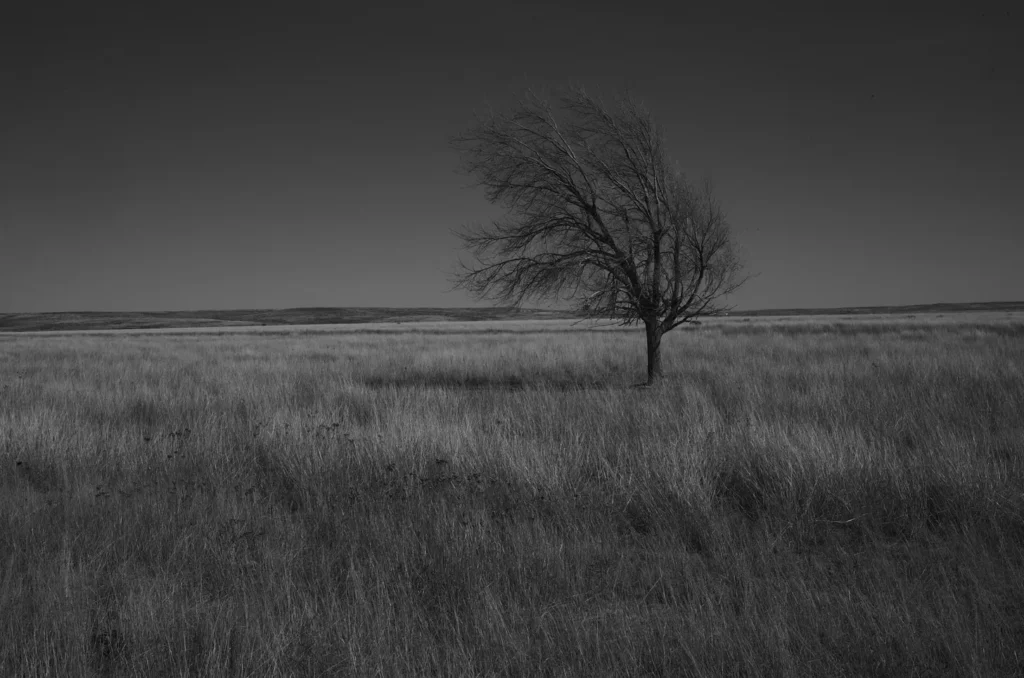
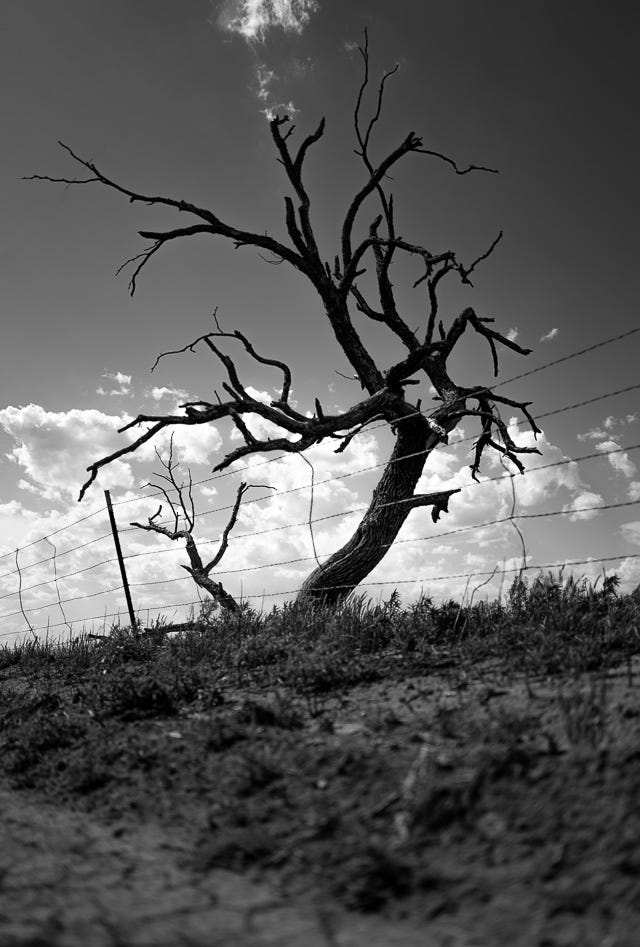
So, what could be unique about landscape photography in black & white?

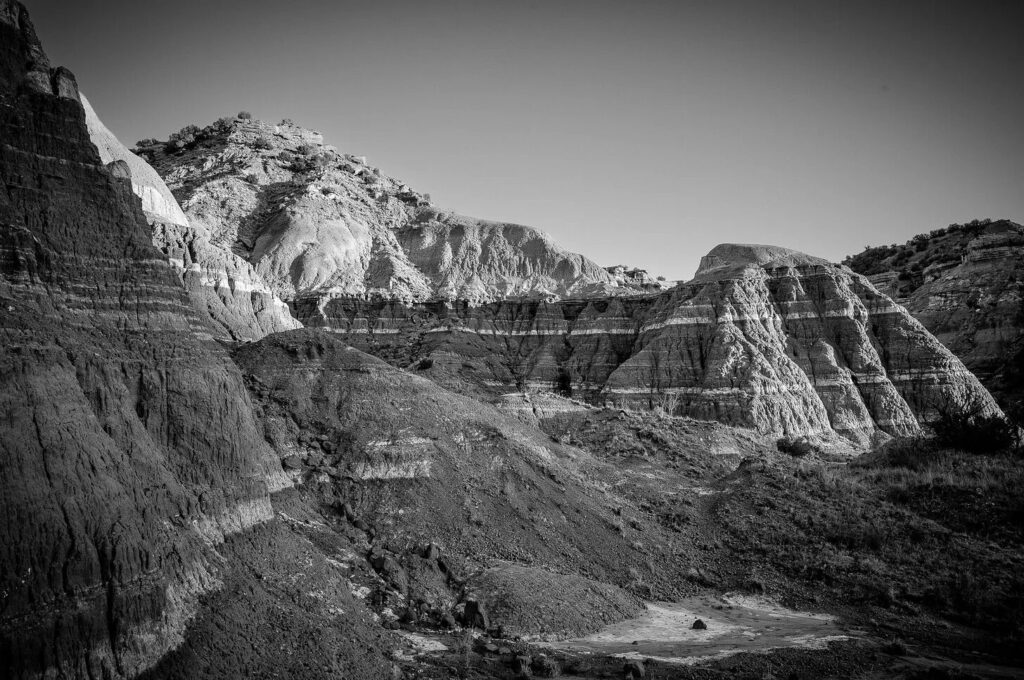
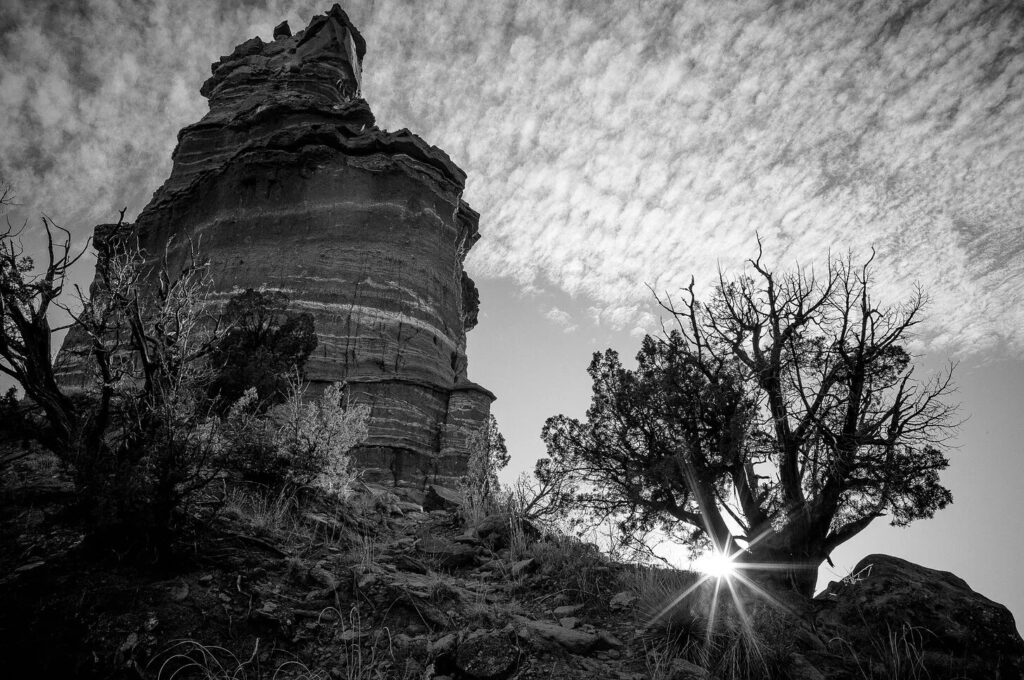
Do the strata of Palo Duro Canyon have a soul?

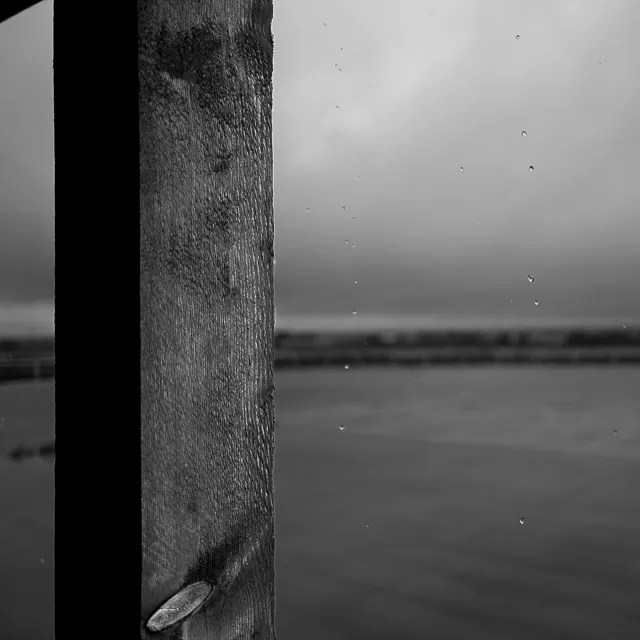
They certainly exist more prominently in black and white. In color, the bleached layers get lost in the rust. But in monochrome, they have their own life.

And it’s not because they are the white and everything else is the black. The more pictures I took, the more I realized that in the black & white pictures I liked the most, there is neither true black nor true white. The shades between are what make the image.

The soul exists in the continuum of the gray.

It was at this time that, in my non-photography life, I reached a point of frustration, based on a single idea—that my time was being spent in ways that benefitted others more than myself. And I was ready for that to change.

I tend to get obsessive about new ideas.

In this case it involved the decision to make wholesale changes, put an end to the things that put me where I was. Stop it all, in fact. Change in every way imaginable. If I was unhappy with one thing, I should change everything.

In psychological parlance this is called—wait for it—black and white thinking.

This is the trap we fall into when we see one failure as an indictment on all areas of our lives. One work mistake makes all work terrible. One personal shortcoming makes me worthless. One unkind word makes that person terrible.

It is easier to think this way. It requires less effort to see beyond the obvious or the one-time event and really maintain curiosity and openness. If we can just assign value to everything and everyone once, it makes life a lot more simple.

But of course, this is a terrifying measure for others to use on us. All-or-nothing thinking is not how the world works, and it robs us of deeper, more meaningful opportunities for experience, growth, and relationships. The conflict between you two might be terrible. But the resolution of it might be wonderful to a level you did not know existed.

The harm done is unthinkable. But the strength built from working through the harm is life-changing for you and life-giving for others.

The black and the white are there, but they are traps. If you stay there, you miss so much. The soul of it all exists in the continuum.

Each day, among the many courage-summoning mantras I utter to myself, I’ve added this one: Where will I find the gray today?

Instead of limiting people and circumstances to good or bad, helpful or harmful, right or wrong, how can I be open to the many possible connections that open up all around me? What experiences, lessons, creative thoughts could I receive by looking instead of labeling? What can I see today?

There is infinite potential between the black and the white.

Sounds risky…

That thing you’re scared to do?

It’s because it’s risky, right?

It could go wrong. It could be embarrassing. It could lose money. That’s the risk.

But if it goes right? Turns out, there’s risk there, too.

It could work–at first–then fail.

It could make money–then lose more.

It turns out risk is at the next step too. And the next. And the next.

It sounds overwhelming, until you realize you are where you are now because of all the risks you’ve already taken. In fact, you’ve taken risks more than you realize. For that matter, life is a risk. Work risks time, effort risks energy, love risks rejection.

You are a pro when it comes to taking risk – so much so that you do it daily without even knowing it!

That current risk doesn’t seem so big now, does it?

Growth is not the same as More

The marks on the pantry wall, just inside the door frame, each have a name and a date marked next to them.

The marks that are close together are 4 years apart – the difference in age between my brother and me.

Then his marks get much higher than mine.

This is what we learn growth means. More. More height. More knowledge. More ability. More degrees. More money.

But more is a trap.

At some point, growth is the ability to be more – not do more, not have more.

I can be more myself today, and there is no other growth – physical, monetary, admiration – that will make me more myself than that being. Whether that being is discovered by action, reflection, receiving and giving love, or any number of ways is the joy of the journey. It will probably change often.

But the mistake is to replace the journey of growth with the pursuit of more.

Never follow a hippie to a second location

(30 Rock had the best lines)

Substack is cool, it’s trying to build its own ecosystem. A lot of writers who write on Substack say they love writing on Substack. 
I like it okay.

The technological advantage that t has, in theory, is the network effect. If I was a diligent writer I’d be writing often, reading often, making friends. Then I’d be linking to their Substacks and they’d link to mine. 
And so it goes.

I have followed a few of those links and been richly rewarded.
I have followed others and lost time I’ll never get back.

It is a funny thing, this “following” we all do now. I “follow” on Instagram, Substack, email, etc. But part of following is trust. If I give you a follow, I trust you’ll either benefit my time or at the very least, do no harm.

So when Substacks lead to bizarro left fields, I feel betrayed. Like I was lied to. Maybe it’s because I was around for the html early days, when typing a link was work. It means more to me.

Plus, the colors distract me from following the writer’s line of thought.

So, link well, friends. 
And never follow a link from someone you don’t trust. 
You don’t know where it’s been.

The Hairs Catch Most of It, Anyway

The inevitable slide continues…

I was refilling my trusty Yeti with Diet Dr. Pepper at the gas station soda fountain when the explosion happened.

It caught us all off guard, a gasp could be heard from the wine aisle.

I kept moving. Playing it cool is my automatic reaction.

But as I turned away from the array of soda nozzles, I looked up to see the gray-haired culprit, his face bearing the casual smile of oblivion—as if he didn’t know what he had done.

But he knew. Every old man knows that his sneeze is loud enough to tear a hole in the space-time continuum.

I know, too.

For years, I thought it was just my dad. The dread at family gatherings when, as a father of napping children, I would clinch at the very thought of him sneezing in the same house. Or the shock when, while watching television or staring into the void of my phone his sneeze came quick.

My wife was caught off-guard by it for years. She got used to it. My kids, amazed, may never really adjust their young sensitive hearing to the brute force attacks of it.

At least we could all laugh about it together—or so I thought.

I don’t remember when it started—when the ancient daemon ghost of elder masculinity invaded my diaphragm—but it’s there now. And will be forever. I mourn the memory of pardoning myself politely after a muffled snuff, the forced suppression of a sneeze. Or, and I swear this true, when I could just pinch my nose and make the thing go away altogether. If I tried that now, the pain would be excruciating, not to mention the projectile ear wax would penetrate the sheetrock across the walls of whatever room I was in.

There comes a time in a man’s life when his age takes over. His grooming needs increase just as his grooming awareness decreases. His sneezes convert from decibels to Richter-scale measurements. He begins talking about himself in the third person.

He’s there now.

The torturous purgatory for me, though, is knowing what I have become. Unable to turn back, but able to know what I am inflicting upon the ear drums of those around me. I feel it coming, the sneeze, almost every time, my eyes widen, knowing the mockery that will be following. If possible, I warn those around me—pleading with eyes watering for them to save themselves. It’s too late for me, the longer I hold it, the more my nose rises heavenward, the worse it will be.

And then—it happens—and all the people in my home or the convenience store stare. I am becoming the old man. He waits for me—that oblivious smirk is his knowledge that all things pass—youth flees. I envy his apathy. Time and minor nasal irritation will drag me there.

But the dirty secret—the release felt after a sneeze of this magnitude is so blissful—that’s the real reason we don’t stop it. I’m still young enough to risk sharing this secret—all the older men have wandered off to use the bathroom by now, anyway.

We sneeze this way, because it feels good.

And at our age, not much else does.