I’m going to guess I first heard the song when was 12 or 13. I fell in love with its hook. I don’t know where I heard it first, though. And I’m pretty sure I didn’t hear the whole song—just the first few lines of the chorus. But it burrowed deep into my soul—that tone, that melody was captivating.
What song?
See, that’s the problem. In 1992, as a young boy whose tractor radio only picked up country or lite-rock stations, I never knew what the song was. I didn’t know the title or the singer. Or if it was a band, for that matter. It was a man’s voice, and kind of had that singer/songwriter vibe—although I wouldn’t have known to use the term “singer/songwriter”—or “vibe,” for that matter.
So, what did we do in the Dark Ages when we had a question like this?
Who sings the song that goes “…..”?
Years. I’m not exaggerating. I went years not knowing the song was titled—
“For What It’s Worth” and the band was Buffalo Springfield.
Plus, it’s a weird title to the song we all know by its opening line, “There’s something happening here.”
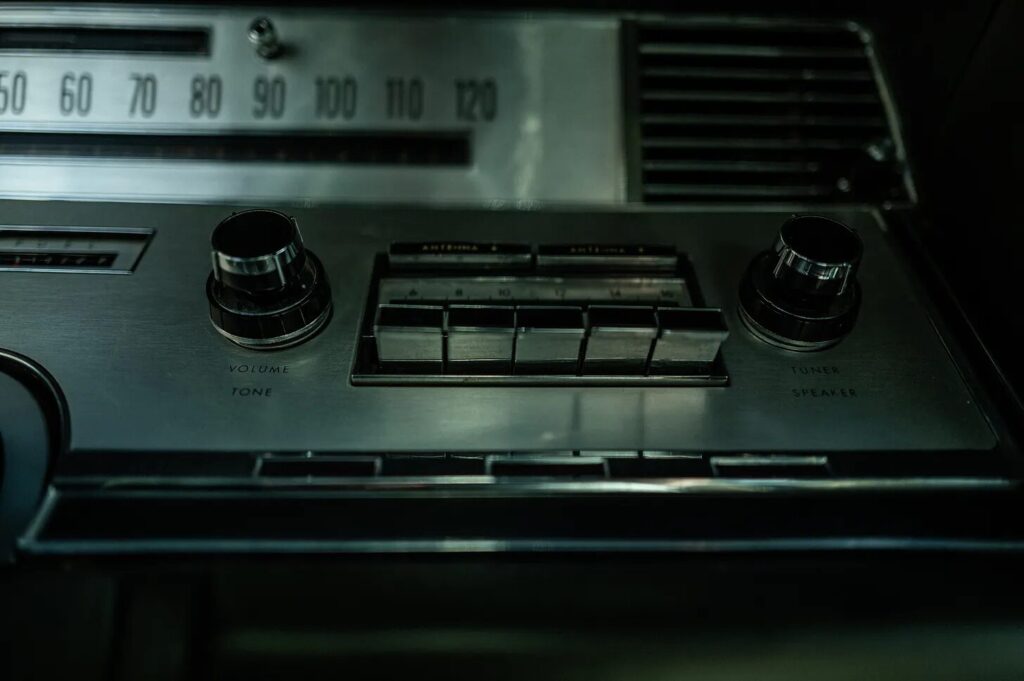
If memory serves, it was 1997 when I finally found out the name and title—by happening across a compilation cassette tape of oldies music, maybe named “Summer of” something? I don’t remember. But I do remember that when the JVC tape deck in my car started playing it, my eyes lit up. I had finally discovered it! I grabbed the cassette case and read the 5-point typeface on the back flap, and my quest was finally achieved.
I always attributed this void in my musical past to the fact that we were in the Dark Ages, before the advent of the internet. We had knowledge, sure, but the way we shared it—the way we acquired it—took effort. And sometimes, even with effort, we just had to give up on knowing some things.
How could I have figured out what this song was? I don’t remember asking my parents. I was either a teen or a pre-teen, so obviously my parents were useless.
No one my age knew what I was talking about when I tried humming the tune or the lyrics I could recall. Possibly because I was terribly off-pitch. But also, they might never have heard the song—remember, country and dentist’s office pop was all we had on the radio. I would say that many people in Quitaque, Texas knew the song, but the ones who did were not the ones around me when I thought about wanting to know its identity.
This was not a knowledge problem, but a blinders problem. I didn’t go looking for an answer because I immediately forgot I had the question once the song was over—wherever I heard it or snippets of it.
I consider myself a curious person. In fact, it is the thing that has become my best skill in the past few years. I doubt it is a new talent. I bet I was at least an above-average-curious kid. So I don’t think it’s a result of intellectual laziness that I had a lot of unanswered questions at that age.
I think the world I lived in was just smaller.
We have a child gate at our house. Our children are too old for a child gate, but we use it for the dogs. The gate is probably 18-24 inches tall. We prop it against a doorway to keep the dogs in our out of a room depending on guests or messes or whatever. It works. Always has. Our dogs are about 50 pounds each, and back in my ranching days, they could jump from flat-pawed into the bed of my pickup, which is quite tall.
They couldn’t jump the gate as puppies, so they remain convinced that is still the case.
Of course this applies to humans as well. When we don’t know what we don’t know, it takes either great curiosity or great revelations to shakes us from that state.
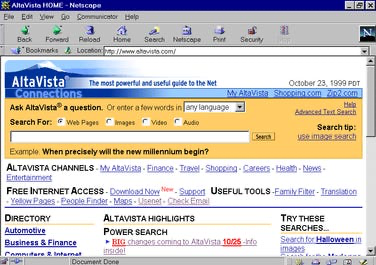
Alta Vista was the thing that did it for me.
The Internet began with the great Search Engine Race. Lycos, Infoseek, AskJeeves—if you’re naming more in your head, you were there. These and many more all paled in comparison to the best search engine of them all. That’s right, AltaVista. The dominant treasury of information was contained in the magic files of altavista.com—the biggest search engine of 1997. At least that was the conclusion drawn in the binder at Caprock Public Library.
Volunteering had just begun to look good on college transcripts in the 90s, so I was trying my hand at climate-controlled work for free as a way to avoid the tractor and the cage of country music and LiteRock 97.
I would go for an hour each week and use AltaVista to look up questions that people in Quitaque had—or something like that. I don’t remember scanning for much—because people didn’t come to the library for answers to questions no one else in town could answer, they came to the library for books. Research was its own separate world. It was not by reading that you found answers, it was by scouring giant encyclopedias, WorldBooks, Atlases and who knows what else—literally—who knows? Microfiche?
The world was not yet full of information then—it was devoid of it. Little did we know—no, not even little—in no way did we know that we, all of us, were in an information desert. But even if we had known that, we’d have missed the fact that the desert was actually a beach upon which the tsunami of information was barreling toward us, about to drown us all with anxiety parading as “research.”
I love learning, but there are times I miss the desert.
I can know the inner thoughts of celebrities, politicians, pastors and anyone on earth, instantly.
Or, I can learn a new skill in a matter of minutes with just a casual search.
I can be coerced and manipulated into anger and action, all before my mind actually has time to be angry.
Or, I can connect with people thousands of miles a way to support, encourage and learn from each other.
I can diagnose, suffer, listen and tell, again and again and again, daily, hourly, minute by minute.
I can find an answer to any question—right, wrong or irrelevant—at any moment.
I have access to more than my brain can ever think to ask for.
The knowledge is overwhelming and powerful—it is good, it is bad, it is…
What it is ain’t exactly clear.